FiRe: Fixed-Noise Refinement for Visual Counterfactual Explanations

BMVC 2026
Technical University of Denmark
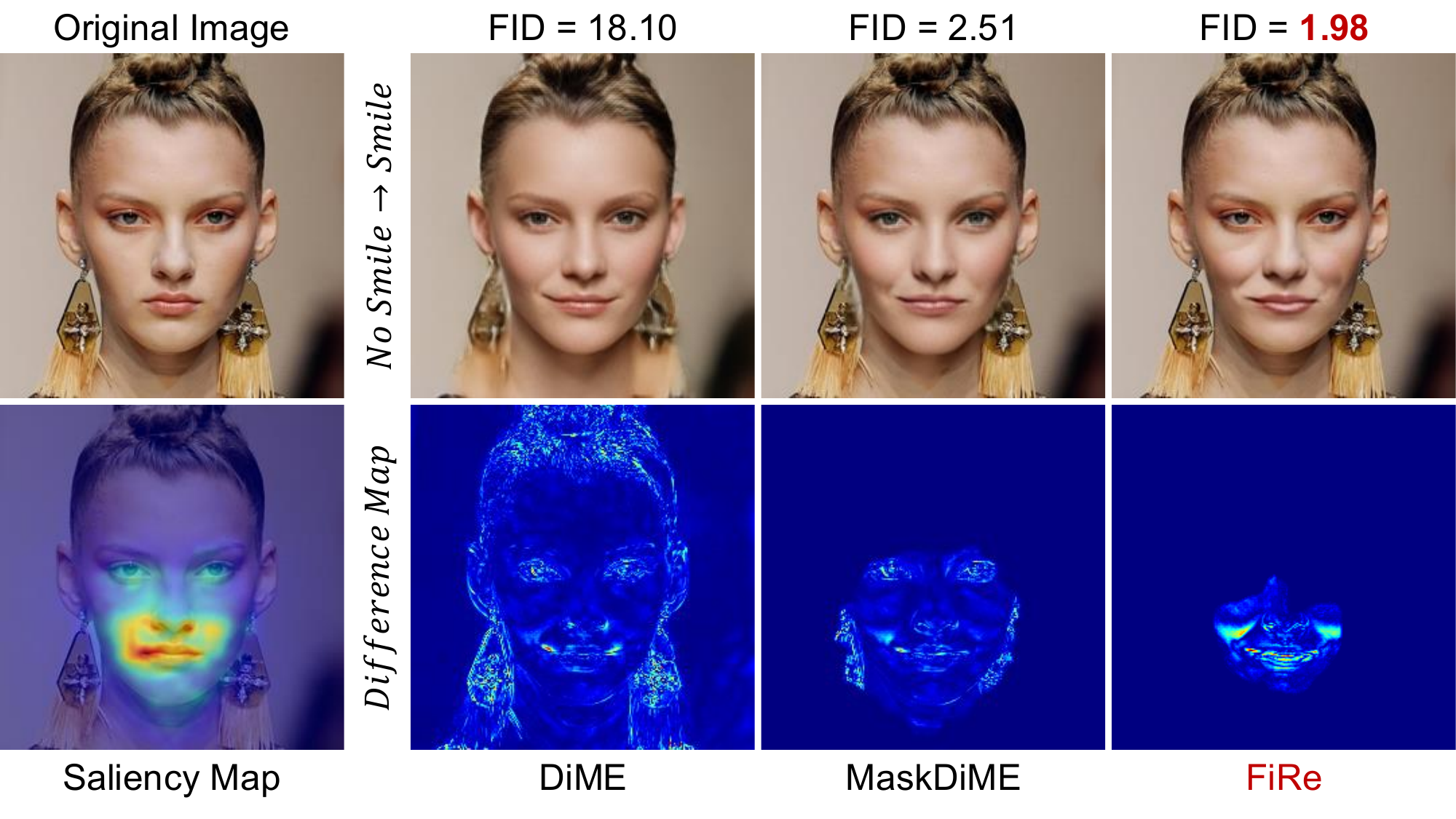
FiRe visual counterfactual examples compared with prior methods

FiRe generates localized visual counterfactual explanations through efficient fixed-noise refinement.

Abstract

Visual counterfactual explanations reveal how an image could be minimally changed to alter a model's decision. Existing diffusion-based approaches commonly edit along a long reverse denoising trajectory, coupling semantic editability with spatial control while repeatedly estimating clean images for classifier guidance.

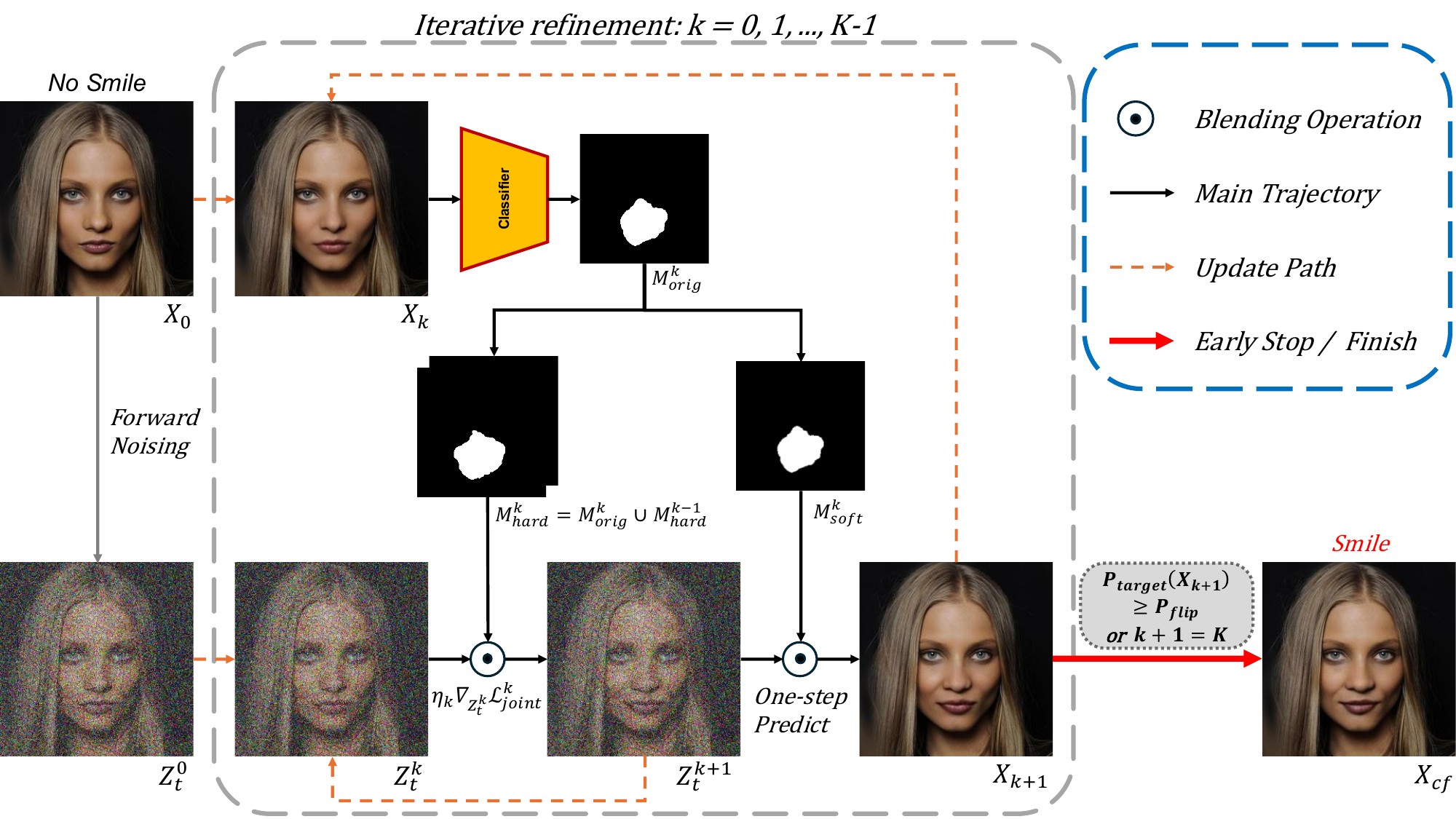
We introduce FiRe, a fixed-noise refinement framework that maps the input to one intermediate noise level and iteratively optimizes the noisy state there. Pixel Mean Flow provides direct clean-image prediction, while dynamic dual masks, adaptive guidance, and early stopping keep edits localized and decision-relevant. Across five tasks on CelebA, CelebA-HQ, and CheXpert, FiRe delivers competitive or state-of-the-art counterfactual quality with substantially lower computational cost.

Method Overview

FiRe replaces reverse-trajectory editing with iterative refinement at a single fixed noise level. Pixel Mean Flow directly predicts a clean image for classifier guidance, while dynamic dual masks control where changes accumulate and where they become visible.

Overview of the FiRe fixed-noise refinement framework

Efficiency

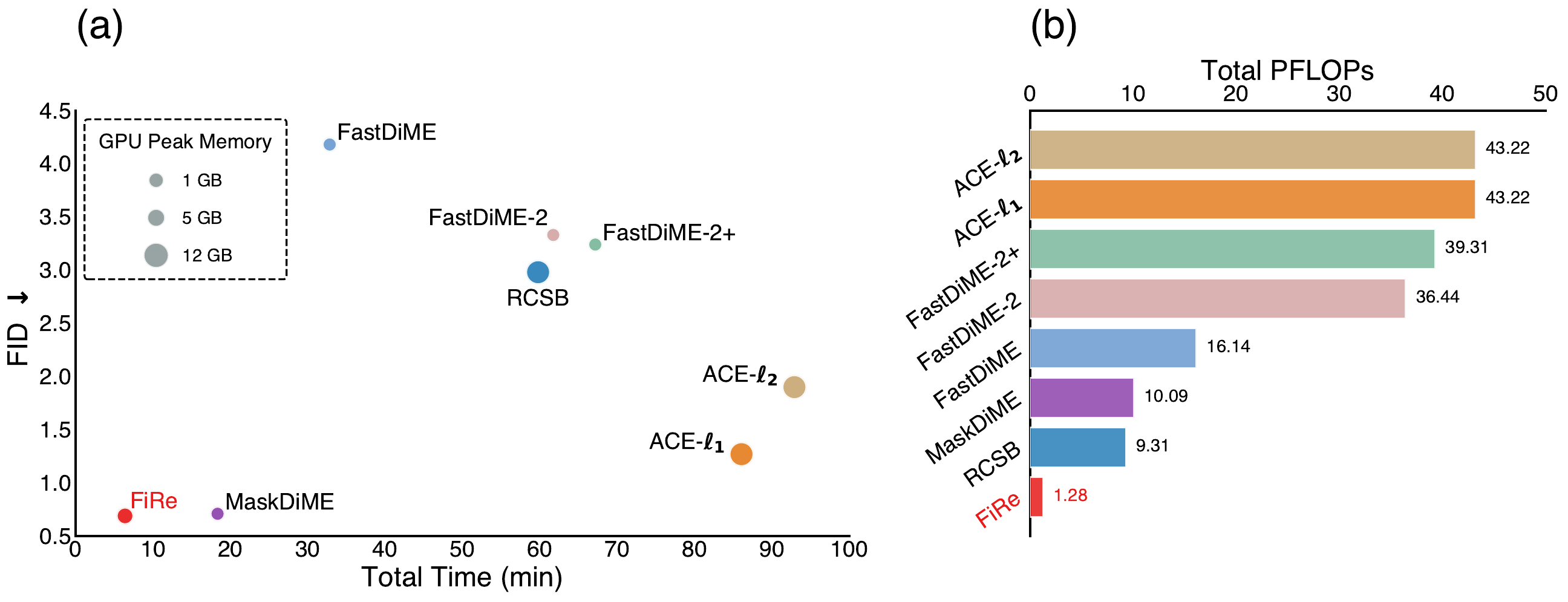
FiRe generates 1,000 counterfactuals on CelebA Smile in 6.37 minutes with 1.28 PFLOPs, achieving approximately 3× faster inference and 8× fewer FLOPs than the strongest recent baseline.

Runtime, memory, and computational cost comparison

Visual Results

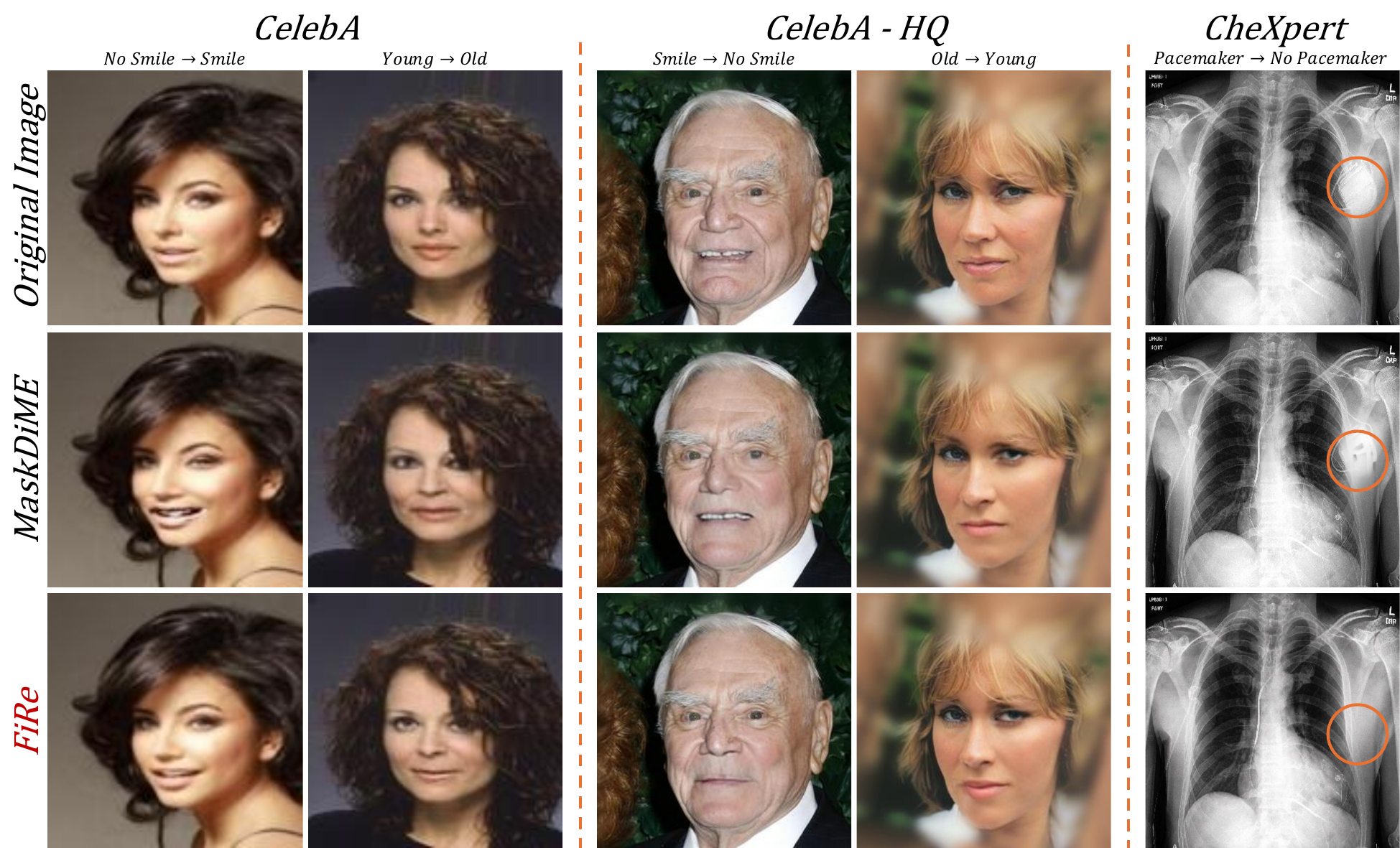
Qualitative results on CelebA, CelebA-HQ, and CheXpert show targeted counterfactual changes while preserving content unrelated to the classifier's decision.

Qualitative FiRe results on CelebA, CelebA-HQ, and CheXpert

Ablation Study

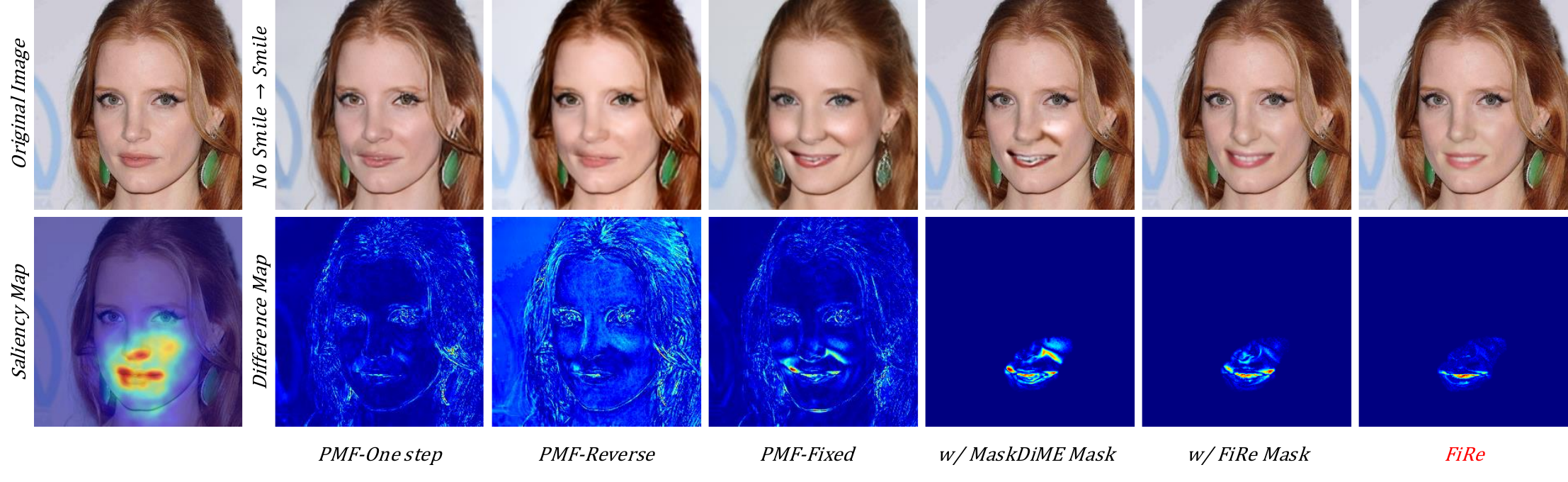
The build-up study isolates the contributions of direct clean-image prediction, fixed-noise optimization, dynamic dual masks, adaptive guidance, and early stopping.

FiRe component ablation and difference map analysis